
Islamic Development Bank fly-in over planned Euro 405m SGR funding
Islamic Development Bank fly-in over planned Euro 405m SGR funding
Top officials from the Islamic Development Bank (IsDB) have held several discussions with Government of Uganda towards firming up Euro 405m IsDB’s part funding to Uganda’s Standard Gauge Railway (SGR) project.
The IsDB has proposed a concessional loan and co-financing arrangement for the project. Uganda is co-financing the project alongside other partners and has already committed Euro 75m towards ongoing early works.
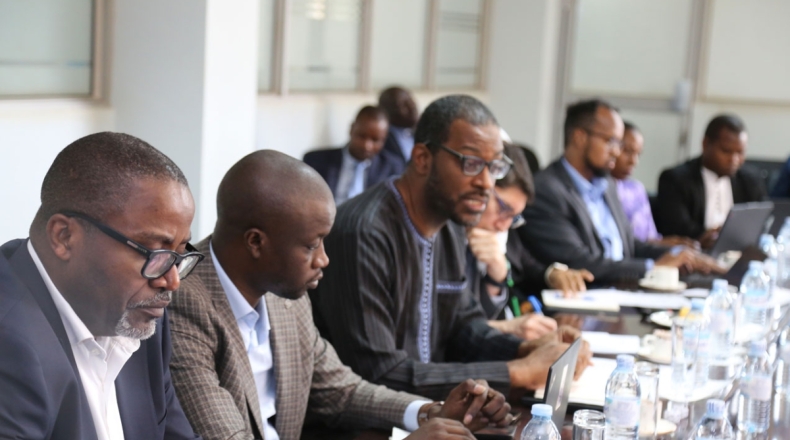
The IsDB Appraisal Mission commenced their discussions on Monday February 16, 2026 with a meeting with the SGR Project Management Unit at the SGR offices in Nakawa Business Park.
During the meeting, the SGR team highlighted Project progress including activities under the Limited Notice to Proceed (LNTP). The LNTP signed between Government of Uganda and the Turkish firm Yapi Merkezi contracted to construct the Malaba- Kampala Eastern Route SGR provides for early works within a nine-month period. These works include setting up of the construction camps, sleeper factory, batching plant among others all in preparation for commencement of actual construction.
During discussions, the SGR Project Coordinator Can. Eng. Perez Wamburu also highlighted progress on land acquisition noting that compensation of affected people entered the final phase in Kampala district in December 2025. The SGR covers 12 districts from Tororo to Kampala
The IsDB also toured the SGR Right of Way corridor in Eastern Uganda and made stop overs at critical infrastructure points including the location of the SGR Nile Bridge next to Mada Hotel in Kimaka village outside Jinja City. The team accompanied by officials from SGR also toured the camp site in Madhigandere, Iganga district where LNTP works are ongoing and are 70% complete.
The IsDB team appreciated the detailed project information provided by the SGR team during the Appraisal Mission tour.
Uganda is set to develop about 1,724KM of SGR in a phased manner starting with the Malaba- Kampala Eastern Route (272KM).
Currently, Uganda suffers high costs of doing business driven by expensive and unreliable logistics because it is landlocked. This reduces its attractiveness for domestic and foreign investment thereby limiting job creation and industrialization further compounded by a high road maintenance burden, traffic congestion and road safety risks as freight shifts to roads.
A modern SGR will therefore enable lower unit freight costs, faster transit times, higher reliability and greener transport, casting Uganda as an attractive investment hotspot.